
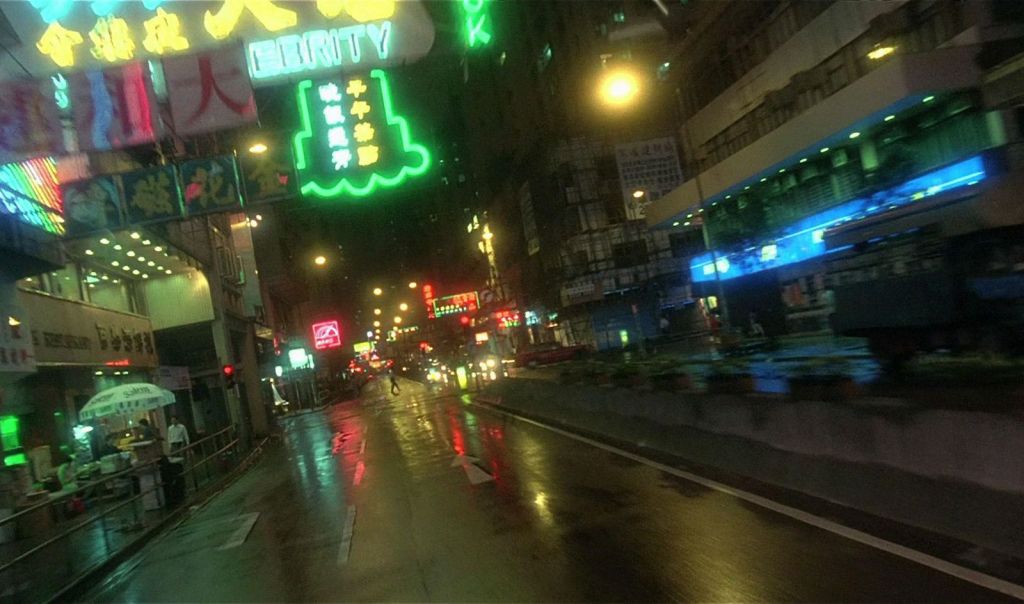
The first time I watched Chungking Express was in Jakarta, during one of those heavy evenings so thick with humidity that the city felt like a wet sheet plastered to your skin. The AC above me hummed while the television tinted everything a sickly yellow. Outside, rain lashed against the road, filling the cracks with dirty water. Inside, Tony Leung stood before a row of tinned pineapple, the date stamped in red, and I didn’t yet know that this film, or the man who made it, would become a permanent part of my emotional landscape.
At first, Chungking Express only triggered my motion sickness. The pacing was too fast, then too slow, the camera swerving and hiccuping as though it had a mind of its own. And yet something in it gripped me, something that moved beyond understanding: the loneliness, the sweetness, the way heartbreak felt more like a long, humid walk home after a party you should have left earlier. It was my first real lesson in how art doesn’t need to make sense to make itself at home in you.
Wong Kar-wai, for me, is less a director and more a weather system. You don’t so much watch his work as endure it, as if you’d been caught in the wrong storm, drenched and strangely grateful. You don’t watch his films so much as you live inside them.
Growing up in Hong Kong, a place perpetually disappearing even as it grew, Wong seemed to internalize the déjà disparu that Ackbar Abbas described. His films carry that imprint: the love story that is already over before it begins, the cigarette burning out before you can finish your thought, the city swallowing itself in neon. His characters drift through cracked hallways and narrow staircases, moving like ghosts who have forgotten they are dead.
Wong builds his films out of humidity and chance: the wrong glance at the wrong moment, the train you just miss. In his world, nothing happens, and yet, inexplicably, everything does.
I encountered In the Mood for Love during my first winter in California, a particularly isolated COVID-19 winter when homesickness clung to me like a wet shirt. I remember sitting on the floor of my dorm room, watching Tony Leung and Maggie Cheung glide past each other in impossible slow motion. They never kiss. They barely touch. Yet it remains one of the most erotic films I have ever seen.
Wong captures the space between people with almost unbearable precision. The way Chow and Su nod stiffly at each other in the stairwell, their hands brushing the worn wallpaper, made my chest ache not because I wanted them to end up together, but because some part of me understood: the almost was the point.
By the time the film ended, with Chow whispering his secret into the hollow of an ancient stone wall, I realized I had been holding my breath. There was no “happily ever after,” no final embrace to wrap it all neatly. There was only the empty stairwell, and the rain that kept falling.
Wong Kar-wai doesn’t just make films about longing; he makes films that are longing. He doesn’t simply ask you to empathize with his characters; he invites you to recognize the hidden parts of yourself and the missed chances you carry.
Watching Chungking Express again years later, after my first real heartbreak, the film shifted. The first time, I had found it funny: the expired pineapples, the messy cops, the girl sneaking into an apartment to rearrange a stranger’s life. The second time, it hit like a bruise, and maybe it’s because I was older and less willing to forgive myself. I realized that so much of love is projection, where we fall not for the person themselves but for the story we tell ourselves about them. Faye Wong dancing alone to “California Dreamin’,” which had once seemed carefree, now looked like survival.
Wong’s mastery is not just in the slow burn of his storytelling, but in the way he builds entire emotional landscapes out of fragments: the flicker of neon, the muted clack of Mahjong tiles, the heavy velvet of a cheongsam brushing past a doorframe. He doesn’t tell you you’re lonely. He shows you by layering textures until you’re suffocated by them.
When compared to directors like Richard Linklater, who traces conversations across years (Before Sunrise), or Sofia Coppola, who builds cool, detached dreamworlds (Lost in Translation), Wong stands apart. Linklater’s lovers have time. Coppola’s characters gaze passively out at alien cities. But Wong’s characters are already stitched into their surroundings, the city clinging to them like a second skin, the humidity wrinkling the air around them. They don’t visit loneliness; they breathe it.
Wong’s Hong Kong is not a backdrop, but a living organism. You don’t walk through it—it presses against you, stains you with its neon fingerprints.
In Happy Together (1997), Wong follows a pair of lovers unraveling in Buenos Aires. The foreignness of the city only sharpens their heartbreak. Watching it halfway through my first year abroad, I found myself recognizing their clumsy arguments, their desperate, stupid hope that things could go back to the way they were if only they found the right street corner. But Wong, like life itself, doesn’t offer that illusion. They can’t go back. We know it. He knows it too.
That might be why Wong’s films feel less like stories and more like memories you never lived. In the Mood for Love smells like rain-soaked shoes. Chungking Express tastes like cheap beer. Happy Together hums like a flickering fluorescent light at 3 a.m. You don’t watch Wong Kar-wai’s films to understand them. You watch to find yourself in the spaces he leaves empty.
If there’s a single tenet Wong Kar-wai has taught me, it’s that endings are never clean. There are no sharp closures in his worlds, only frayed seams and half-finished thoughts. A door closes. A song plays. The rain continues falling.
Wong doesn’t offer catharsis. He offers recognition.
You recognize yourself in Chow leaning against a wall, too tired to fight, and Faye Wong dancing alone, trying to rearrange the pieces of a life that doesn’t quite fit. Recognition in the man whispering his sorrows into a hollowed tree, because sometimes love leaves you with no one left to tell but the earth itself.
I keep returning to his films not for the romance, or even the nostalgia, though both still seize me by the throat. I keep returning to Wong Kar-Wai because his films remind me that longing is not failure. Missing something is not a weakness. There is beauty in the ache, a generosity in incomplete stories, a grace in what remains unfinished.
In a world obsessed with speed, with clarity, with finality, Wong’s work stands as an act of patience and defiance. He asks us to sit with what is incomplete, what’s been lost. And somehow, impossibly, miraculously, he makes that feel like enough.
 yuan0_0
Leave a comment