Now more than ever, we are reading fashion and wearing literature. Clothes imbue the inner self with material reality, granting us the power to choose the identities we represent. The creating and wearing of dress are intrinsically human, where the pieces of clothing we choose to interact with can serve to articulate our ideas and beliefs. Thus, it should come as no surprise that fashion can be a manifestation of literature as clothes become signifiers for our beloved literary figures and works. Where literature translates the human experience into words, fashion transmutes and reflects it back to us. How do you view the world? How do you want the world to view you? Perhaps the answer to these questions can be found in the intersection between the literary and the sartorial.

Whether classical or contemporary, the written word has always been a bottomless well of inspiration for those in the fashion industry. However, it is evident that literary interests have been particularly in vogue in recent seasons. A giant scroll containing text from Jack Kerouac’s On the Road unfurls, heralding the beginning of Kim Jones’ Dior men’s runway. Model Kaia Gerber, who started an Instagram book club in 2020, flaunted a paperback of Richard Powers’ Pulitzer Prize-winning Overstory in front of the venue for Prada’s autumn/winter 2022 venue in Milan. Fashion maverick Jonathan Anderson draws inspiration from literature once again, with the late Irish Nobel laureate Seamus Heaney’s oeuvre at the core of the naturalistic set design and novelist and essayist Zadie Smith sitting front row at Loewe’s autumn/winter 2022 show. But that’s not all. Sound designer Michel Gaubert created a soundtrack featuring a reading of Sylvia Plath’s posthumously published poem Fever 103°, which aligns with the transcendental, surrealist motif of Anderson’s collection. “Pure?” a voice intones ruminatively. “What does it mean?”
The literary spell the fashion scene has fallen under also includes the active participation of some of the most celebrated contemporary voices. A heartfelt letter from author and journalist Mary H.K. Choi that mentions award-winning poet Ocean Vuong is printed for Peter Do’s spring/summer 2023 collection. We’ve even seen contemporary American writer Ottessa Moshfegh, best known for her 2018 novel My Year of Rest and Relaxation, walk for Maryam Nassir Zadeh at New York Fashion Week and pen a short story titled Where Will We Go Next? for Proenza Schouler’s autumn/winter 2022 collection. “We’d considered working with someone who could help formulate our thoughts and ideas into the written word,” say Proenza Schouler’s Jack McCollough and Lazaro Hernandez. “We were blown away by how she managed to conjure the mood of what we were trying to say but in a completely abstract and personal way.” From supermodels curating reading lists to designer campaigns spotlighting authors, performative or otherwise, the fashion industry integrates literature into its corpus.
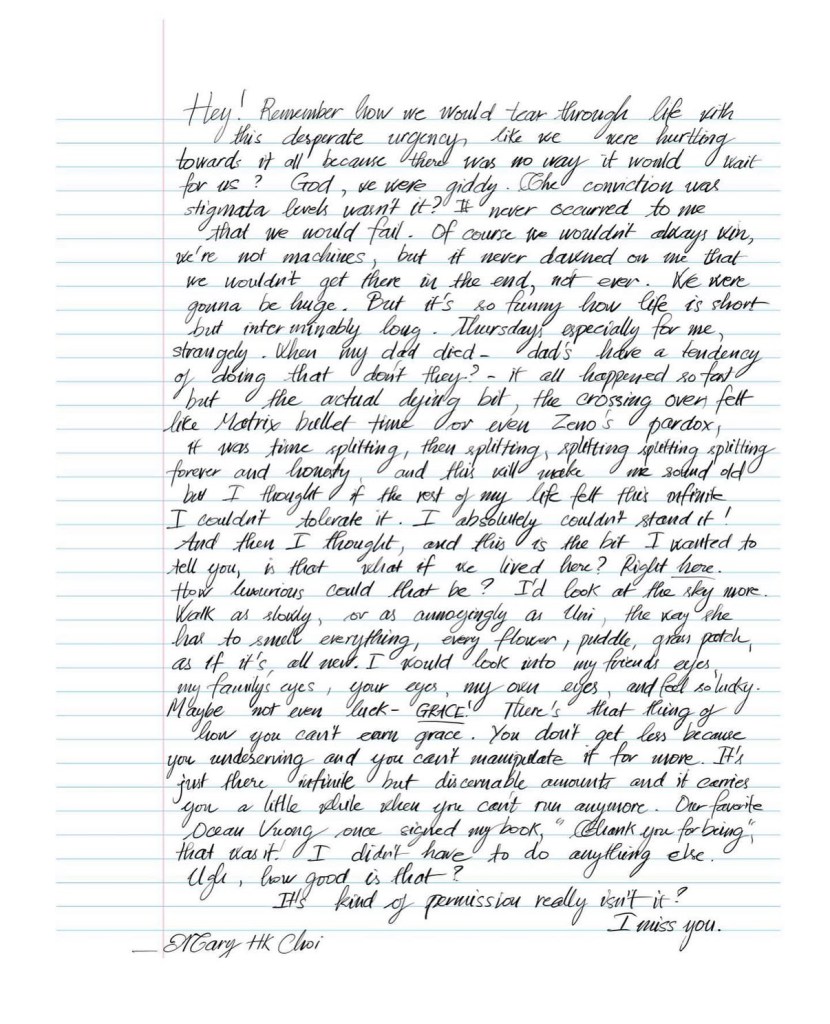
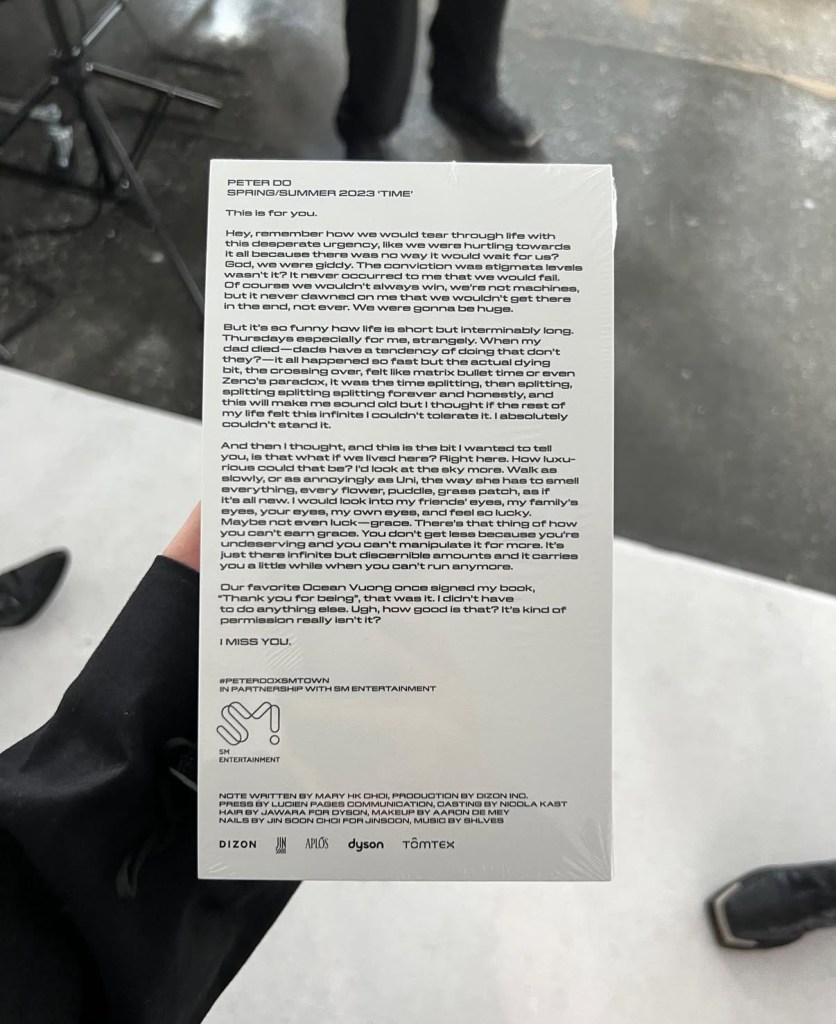
Mary H.K. Choi’s letter for Peter Do SS23, “Time,” via @the.peterdo on Instagram.
Read my commentary on this collection here.
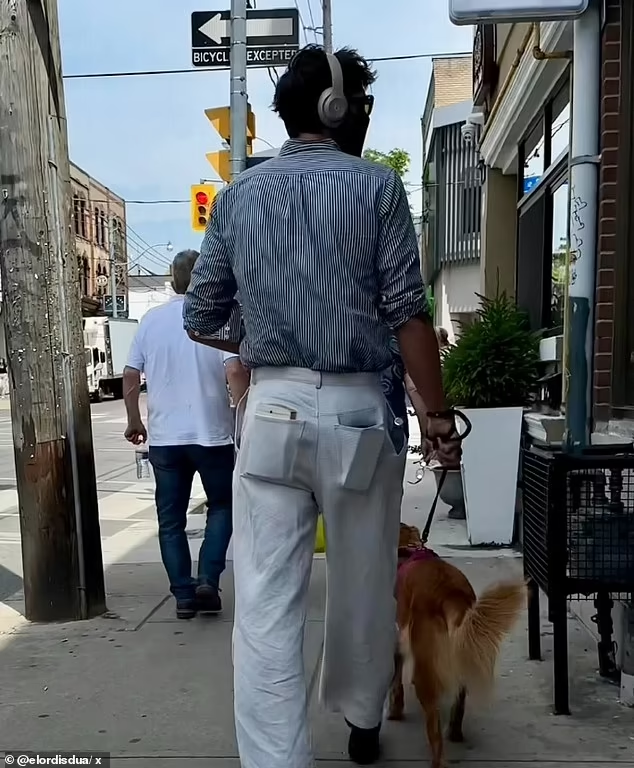
Even outside the runway, the presence of books as style statements has become an enduring visual shorthand. When actor Jacob Elordi was photographed with a well-worn copy of The Stranger peeking from the pocket of his Bottega Veneta trousers—his own iteration of the “literary man” archetype—it set off a flurry of online fascination. The image encapsulated how the book has transcended its role as mere object: it now operates as an accessory of intellect, signaling thoughtfulness and taste within the lexicon of contemporary fashion.
Miu Miu’s own answer to this book–fashion dialogue is its Literary Club, Writing Life, a two-day salon at Milan’s Circolo Filologico that revives the voices of Sibilla Aleramo (Una Donna, 1906) and Alba de Céspedes (Quaderno Proibito, 1952) and treats them not as relics but living instruments of thought. Curated by Olga Campofreda, the program braids readings and performance with panel conversations moderated by Lou Stoppard and Zing Tsjeng, placing authors like Jhumpa Lahiri, Claudia Durastanti, Sheila Heti, Viola Di Grado, Selby Wynn Schwartz, and Xiaolu Guo in direct conversation with these texts. In that setting, the book ceases to be a mere prop and becomes a stage direction for how women write, work, mother, and dissent. The result is fashion behaving like a public humanities project—an atelier of ideas—where literacy and luxury cohabit, and where the archive is re-worn, re-edited, and re-read in real time.

Panel host Kai-Isaiah Jamal with panelists Nicola Dinan, Naoise Dolan, and Sarah Manguso at the Miu Miu Literary Club, Milan Design Week 2025. Photo: T Space / Courtesy of Vogue.
The emergence of this bookish mode in the fashion industry can be attributed to the “aesthetic of bookishness,” a term coined by Jessica Pressman in a 2009 essay to define the display of literary production and consumption in the online media environment. “Books become aesthetic objects that blur the boundaries between reality and fiction by connecting their book-bound body to the virtual world of digital information,” Pressman writes. The romanticization of literature and academia on social media, especially TikTok, is an obvious manifestation of the aesthetic of bookishness. The physical book is far from obsolete, pervading the digital world as both reading material and a definitive display of culture and intellect and providing a stark contrast to the ever-shifting ephemera of accelerated trend cycles. In fashion, the book exists as both an accessory and a tangible token of ideas and beliefs.
In a noisy online environment oversaturated with short-lived content, it is natural to seek something of substantial value to represent and hold on to. To many, this is literature, fashion, or both. What does the book convey about the reader? What do the clothes convey about the wearer? When uninterrupted, rapid-fire consumption becomes the norm, we must extricate ourselves from the looming, almost irresistible desire to pursue whatever is newest and shiniest. By engaging with objects that hold symbolic value, we can signal codes that make up our authentic identities. In this regard, both fashion and literature enable us to crystallize abstractions and communicate meanings–to embody concepts and fashion narratives.
That being said, this literary trend, just like any other trend, can be harmful if excessively participated in. Trends comprise curations of commodities that are assigned philosophies, granting people access to a sense of collective identity or belonging to an internet subculture. As cultural critic Charlie Squire wrote, “Radical principles of joy are misunderstood; the fetishization of the commodity is mistaken as an expression of self-love and the cohort of consumers within a trend is mistaken for a group bonded in solidarity.”
The acceleration of trend cycles raises concerns for mindless consumption and the accumulation of textile waste, the minimization of which can only come hand-in-hand with the recontextualization of our relationship with clothing. Sartorial codes are arbitrary and fluctuating, never fixed. A certain article of clothing may communicate a specific meaning now, but it will undoubtedly signify a different message in the future. Now that trends gain and lose momentum at an unprecedented rate, it is imperative that we partake in them mindfully so as to prevent lasting environmental consequences and the excessive flattening of cultural movements.
The mindful consumption of fashion also endorses authentic self-expression through the curation of one’s personal style, which entails associations and signifiers behind how an individual presents themselves to the rest of the world. Instead of blindly subscribing to fleeting trends, those with developed personal identities and styles move with intention, investing in pieces they have a personal connection with and can reimagine if need be. By honing in on a wardrobe that holds personhood, you can break free from the algorithmic echo chamber and honor your exploration of your individuality and philosophy. Your wardrobe will never go out of style as long as you wear and care for pieces that move you.
When fashion meets literature, we see the merging of two different yet deeply intertwined forms of self-expression and expand our intrinsic power to communicate with others and ourselves. As the literary and fashion worlds collide and distinguished doyennes play a part in each other’s creative visions, we must consider our associations with various sartorial and literary ideologies, interactions with identifiable cultural signifiers, and how much of our wardrobe aligns with our ethos. In an ecosystem of unceasing impermanence where concepts and objects alike decline in value more rapidly than ever, molding a personal narrative you hold close to your heart is an unyielding act of subversion. Now more than ever, books do make looks, but whether or not you choose to engage should be your decision to make. How will you rewrite your relationship with your wardrobe? How will you fashion your narrative? Be it through the written word or fabric, you can create the self you seek to represent and honor it in your lived reality.
 yuan0_0
Leave a comment