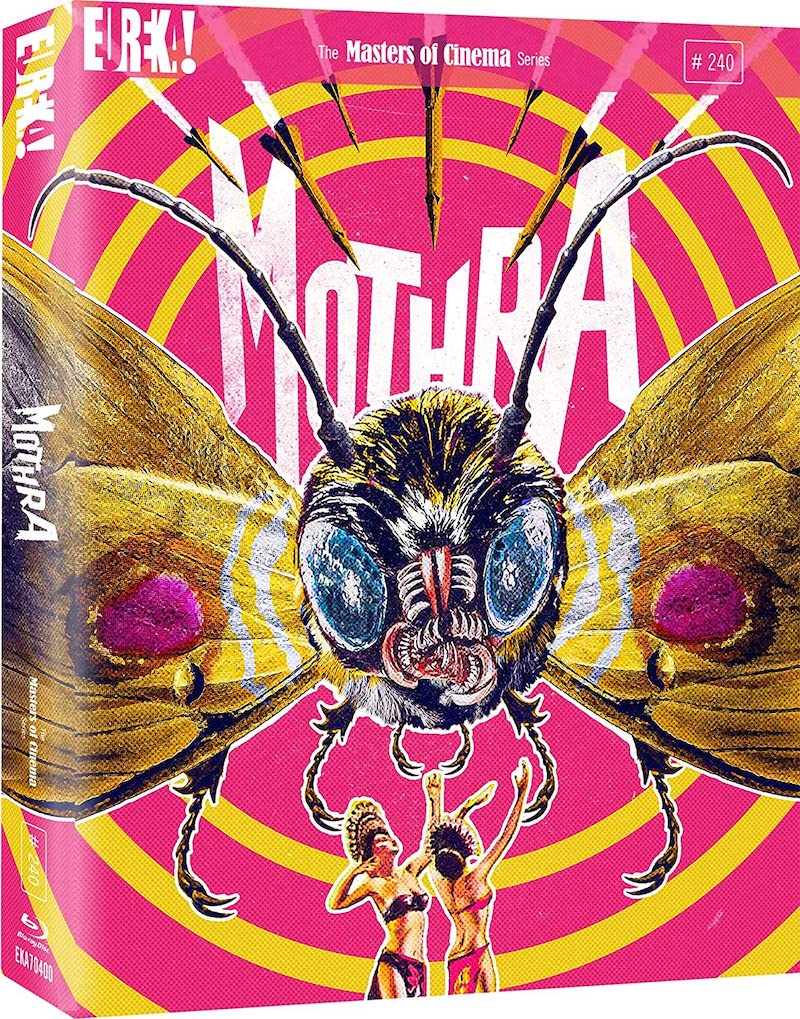
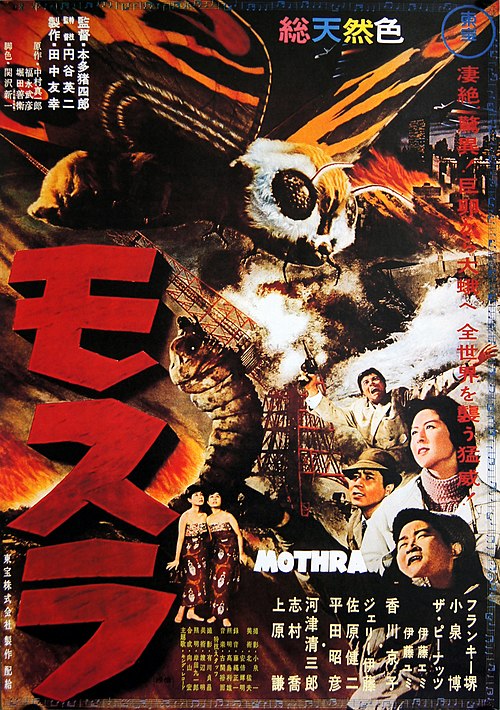
From Mothra (1961), directed by Ishirō Honda, a fascinating allegory emerges that critiques big business and its disregard for the environment. Through the monstrous female creature Mothra, the film conveys a profound message about the implications of unchecked industrial capitalism, emphasizing the need to consider and protect environmental welfare (Rhoades & McCorkle 70). By contrasting Mothra’s symbolic value with that of science and militarism, the movie highlights the recurring failure of humanity to adequately anticipate the dire outcomes of its actions.
Mothra paints a vivid picture of the destructive consequences that can arise when humanity prioritizes profit over environmental preservation, championing greed and exploitation over the survival of nature. The film’s storyline revolves around the exploitation of the Twin Fairies that inhabit Infant Island, the home of Mothra, by greedy entrepreneurs seeking to harness their powers and the island’s resources. This narrative parallels real-world scenarios in which corporate interests lead to ecological devastation (Rhoades & McCorkle 65). Mothra’s emergence as a towering force symbolizes the environmental repercussions that can result from such reckless pursuits, serving as a warning against the shortsightedness of prioritizing financial gain over sustainable practices.

That being said, the film’s portrayal of Mothra as a protector of nature provides a stark contrast to the actions of industrial capitalism, science, and militarism. Instead of acting on aggressive or destructive impulses, Mothra is on a rescue mission. Mothra’s role as a guardian of Infant Island implies a deep connection with the environment, highlighting the necessity of living in harmony with nature. Contrastingly, the characters representing science and militarism—especially Clark Nelson—demonstrate a narrow focus on their agendas, neglecting the wider implications of their actions, and serve as a cautionary tale for society and its impact on the environment.

On top of Mothra, the Twin Fairies, or the Shobijin, are symbolically intertwined with gender power structures in 1960s Japan. The Twin Fairies are depicted as delicate and ethereal, embodying traditional Japanese notions of femininity. Their association with Mothra therefore creates a dynamic that is indicative of the duality of femininity and reflective of the historical context—a Japan that teeters between the fragility and resilience of femininity, and traditional gender hierarchy and modernity. The portrayal of the Twin Fairies and Mothra serves as a testament to the complexities of gender dynamics and the cultural context of the film, allowing for a nuanced exploration of gender and power in 1960s Japan,
Moreover, the film’s imagery is detailed and effectively conveys critical subtexts. For instance, the scenes that show the destruction of New Kirk City after Mothra flies out of its cocoon and travels to Rolisica, a fictional country that represents both Soviet Russia and the United States in the atomic age, include a scene of a dress maker’s shop in shambles. In the scene, a mannequin wearing a wedding dress topples over first, moments before the rest of the shop falls apart (Honda 1:21:50-1:21:55). This detail further emphasizes the disruption of gender relations and paradigms in Japan as women continue to move away from gender-defined societal roles, which are inextricably linked to the institution of marriage.
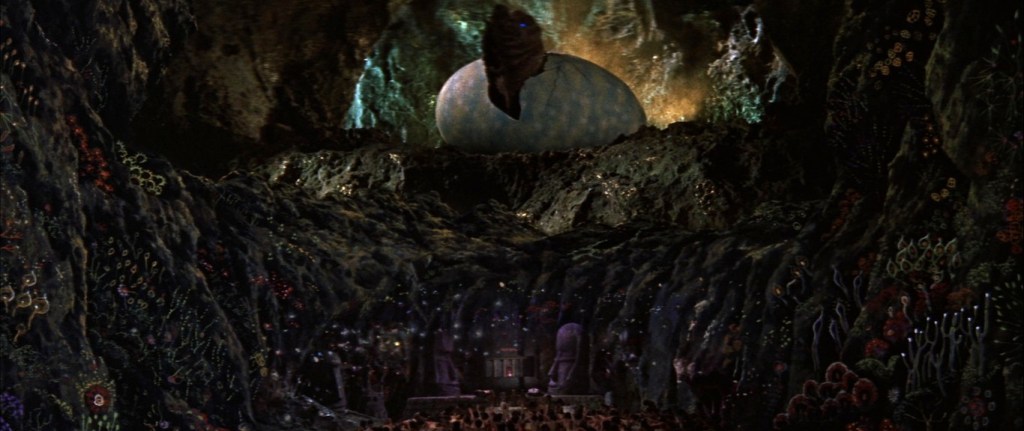
From the Balinese gamelan-esque instrumentals to the island natives’ batik attire, the music and costumes in Mothra (1961) draw heavy inspiration from Southeast Asian, or more specifically, Indonesian, culture and language. The wear donned by the Twin Fairies and island natives are made out of fabric with batik motifs, which is produced through the traditional Indonesian craft of wax-resist dyeing with canting and cap tools. Batik was originally used by mothers to carry infants and children, adding sartorial depth to the costume choices in Mothra (1961), a film that is rich with subtext regarding gender roles in Japan. The background of this fabric also reflects the identity of Mothra as a female creature who lays eggs and whose attacks are “based on protecting others” instead of aggression (Rhoads & McCorkle 54).
Furthermore, the music in Mothra (1961) “aligns nature, the feminine, and the foreign” and its absence in moments tied to “civilization, the rational, and the masculine” places an emphasis on the “binary of woman/music/nature versus man/language/civilization” (Rhoads & McCorkle 57). The music that accompanies the Twin Fairies set them up as intermediaries between the natural and supernatural as represented by Mothra and the humans, untouched nature and civilization as represented by the Infant Island natives and the Japanese (Rhoads & McCorkle 58), and traditional gender structures and female mobility/modernity. The instrumental sounds, which are reminiscent of the Balinese gamelan, could be a stylistic decision as the Balinese ensemble typically sound faster and more thunderous than its Javanese or Sundanese counterparts, making the perfect accompaniment to the film’s kaiju action, island dances, and other scenes that would indicate a sense of urgency or disruption.
Beyond the instrumentals, the original Indonesian lyrics to the Mothra Song, sung by the Twin Fairies or the Peanuts, add to the role of Mothra as a protector and its allegorical nature as a symbol of “both nature and the feminine” (Rhoads & McCorkle 50). The lyrics prior to being approximated to Japanese pronunciations, according to a post on the Niigata University site, and my interpretation as a native speaker are as follows:

Two words are particularly striking: “Indukmu” and “hambamu.” “Induk” directly translates to “mother” and is usually used to refer to female animals who can reproduce. However, in this context, “Indukmu” could be interpreted as “your Motherliness” or “your Motherhood,” underscoring parallels between Mothra and motherhood that extend beyond having the same first four letters. This is an interesting choice of words as there are other less animalistic words for motherliness/motherhood, but “Indukmu” could be a deliberate choice to counter the idea that “female labor did not produce commodities” (Rhoades & McCorkle 53) as the root word “induk” is often used in the context of creation and proliferation. This also highlights Mothra’s “life cycle of birth, transformation, death, and rebirth” which parallels nature as it “brings life out of death” (Rhoads & McCorkle 62).
Meanwhile, “Hambamu” is an interesting choice of word as it is usually used in religious or hierarchical contexts. The word is most frequently used in religious texts to refer to humans when conversing with gods or rulers or begging for their mercy. These lyrics emphasize “the antithetical equivalence” as proposed by Soper and “the little, the feminine, and the native/foreign dichotomy” as embodied by the Twin Fairies (Rhoades & McCorkle 51).
From the intricate musical and visual choices to the nuanced cultural commentary, Mothra (1961) weaves a tapestry of allegorical themes that resonate with its audience. Through the powerful figure of Mothra, the film serves as a critique of unchecked industrial capitalism and its detrimental impact on the environment. The Twin Fairies’ role within the narrative presents a thorough exploration of gender power structures in 1960s Japan, reflecting evolving societal roles. The film’s incorporation of Indonesian, or non-Japanese, elements further enriches its allegorical depth, emphasizing the interconnectedness of nature, femininity, and foreign influences. All in all, Mothra is a compelling piece that offers insights into environmental consciousness, gender dynamics, and the timeless struggle between progress and preservation.
Works Cited
Mothra. Directed by Ishirō Honda, Toho Co., LTD., 1961.
Rhoads, Sean and Brooke McCorkle. Japan’s Green Monsters: Environmental Commentary in Kaiju Cinema. McFarland, 2018.
“インドネシア語のトリビア”. Niigata University Institute of Education and Student Affairs. Accessed 21 August 2023.
 yuan0_0
Leave a comment